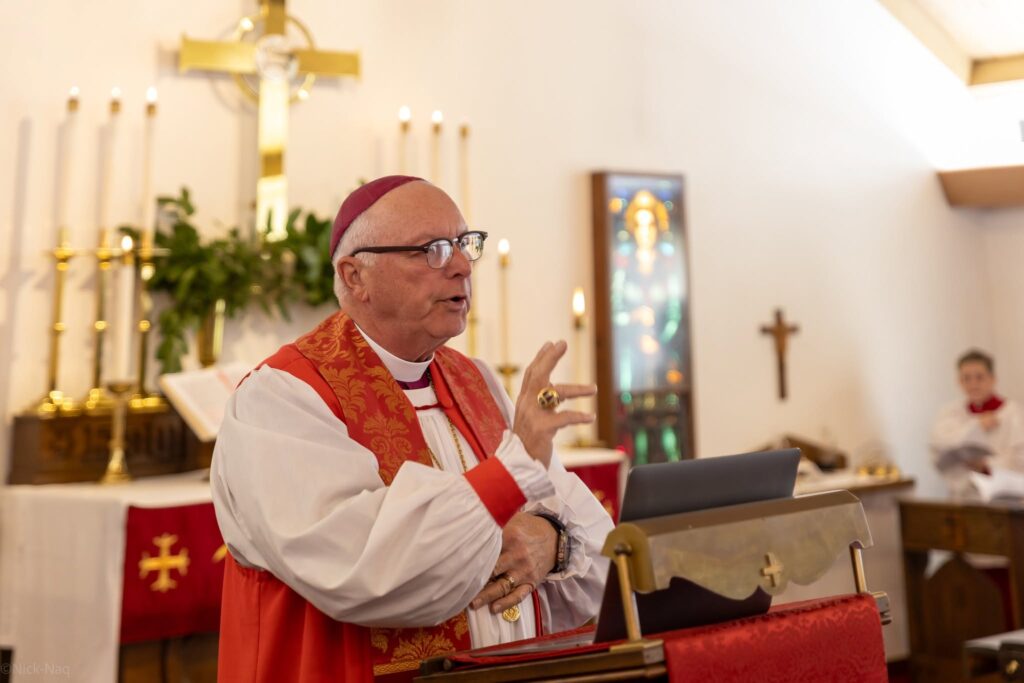

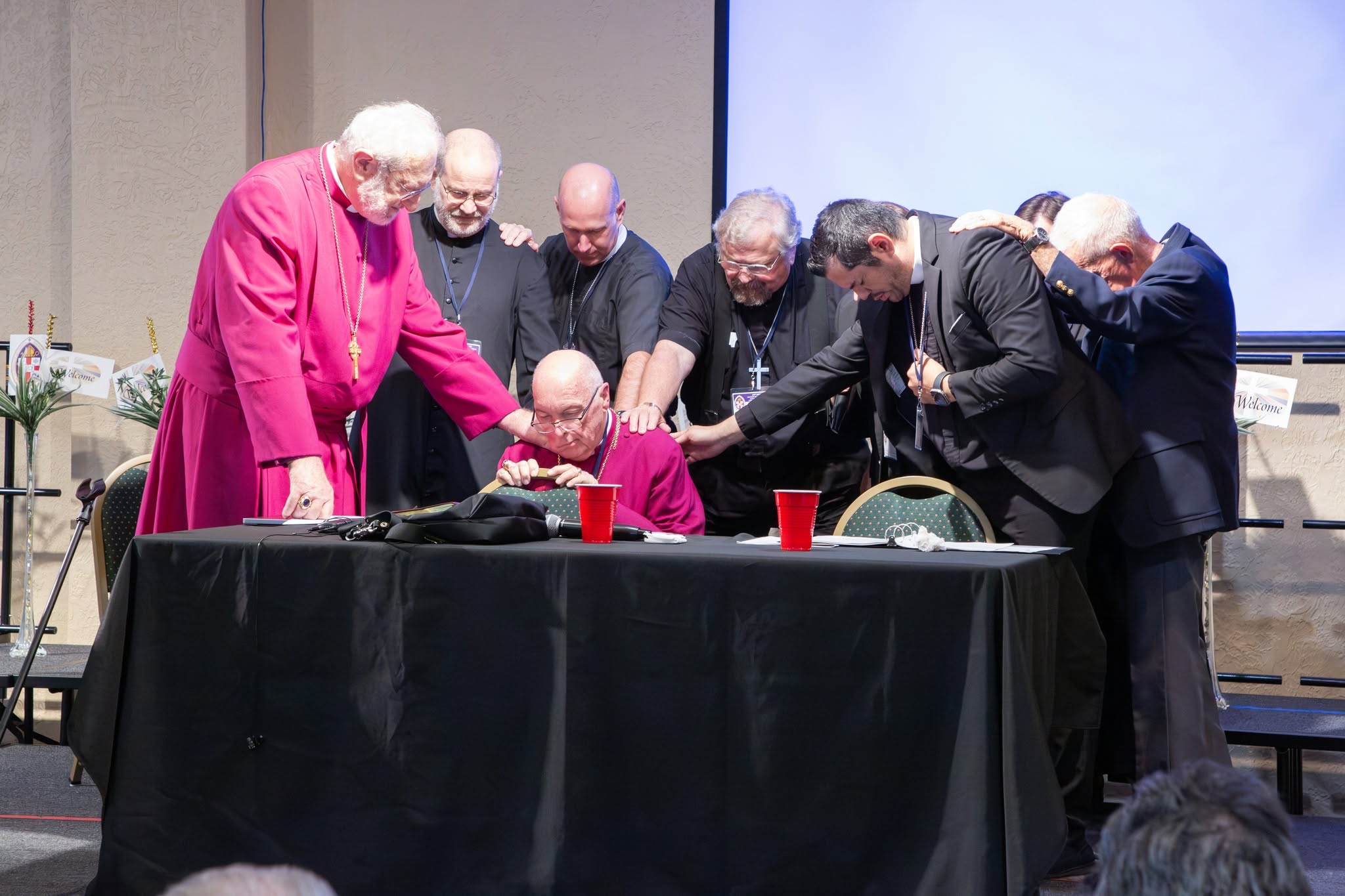

At the 119th Synod of the Diocese of Mid America, meeting October 14–16, 2026 at the Church of the Holy Communion Cathedral in Dallas, Texas, the Most Rev. Dr. Ray R. Sutton, Bishop Ordinary of the Diocese of Mid America, delivered the following Episcopal Exhortation, titled “Entering a Season of Succession.” In it, Bishop Sutton announces the beginning of this season of succession — a three-year process grounded in what he calls the “Timothy Principle” — the biblical pattern of raising up a successor while the predecessor still lives and labors. We share his exhortation here at Saint Paul’s for the edification of the whole Church.
Entering a Season of Succession
And what you have heard from me in the presence of many witnesses entrust to faithful men, who will be able to teach others also (2 Timothy 2:2, ESV).
And the things that thou hast heard of me among many witnesses, the same commit thou to faithful men, who shall be able to teach others also (2 Timothy 2:2, KJV).
St. Paul addresses the subject of succession with St. Timothy. He tells his young successor to have other prepared successors who may carry ministry beyond him. There are multiple levels in this succession. St. Paul has already seen one of his own successors raised up in St. Timothy. Titus was also appointed to be one of St. Paul’s apostle bishops to follow his ministry.
In the text, however, the apostle even commands Timothy to seek out successors beyond himself. They are leaders whom he calls “faithful men.” Yet, beyond Timothy and his “faithful men” is another level. They are those who are able to teach and reach “others also.”
If we note carefully the apostle’s instructions, he mentions three generations of succession. We should not overlook Timothy as the first generation. Those whom he would “entrust [as] faithful men” are the second generation. Then there are the “others also” whom these faithful men reach to be the next generation of leadership.
The verse reveals St. Paul’s critical concern of finding those who can continue the work of the Lord. I like to call it the Timothy Principle. All positions of leadership, lay and clergy, should have a Timothy selected to take over when the leader steps down. For the clergy it’s other postulants, deacons, or presbyters who can take over when they are called elsewhere. For the laity, it’s an assistant on a committee or special project who can step in when the leader finishes his/her term. These Timothy persons should either already be in place or in the process of being put in place.
St. Paul lived in the present but he looked to the future. As for the present, in the title of an 18th century work, the writer named Jean Pierre Caussade referred to it as “the sacrament of the present moment.” Caussade calls the present a “sacrament” because that’s the time grace comes to us. The grace of God may have come in the past, but it came at a present moment in a previous time. The same is true for the future. We can’t take an advance on grace. We must keep trusting in God’s grace day by day. That’s why the present is sacramental. The present is the temporal means God uses to give us grace.
The apostle, while living in the sacrament of the present, actively worked toward the future. He told Timothy to raise up the next generation who could reach another group of successors. In this sense, St. Paul, though living in the sacrament of the present, always kept an eye on preparing for the future continuation and extension of the ministry. Any Church that does not have a Timothy in position to take over will at the least flounder. At the worst, ministries will falter and fail without able successors.
St. Paul’s model of preparing for successors did not start with him. We see the Timothy Principle at the beginning of Scripture and continued into the New Testament. There is the patriarchal system of Abraham, Isaac, Jacob, and Joseph. One patriarch after another laid hands on a successor. There is Moses who did the same with Joshua. There was the prophetic succession of Elijah to Elisha.
Turning to the New Testament, Jesus is the ultimate model of the Timothy Principle. He chose the twelve. There were others such as Nicodemus, Mary Magdalene, Martha, Joseph of Arimathea and so forth. In the Upper Room after the Resurrection, there were one hundred and twenty.
Significantly, Jesus does not directly replace Judas before He ascends into heaven. He uses the Church and her processes to lay a foundation for how successors will be chosen. The Church is involved with picking a successor to Judas, St. Matthias.
Jesus does directly raise up St. Paul, but in the Book of Acts we see the early missionaries hard at work using the Timothy Principle of raising up leaders. St. Paul, in addition to his instructions to Timothy, records the principle in his Letter to the Colossians. He tells this church, “Say to Archippus, ‘See that you fulfill the ministry that you have received in the Lord’” (Col. 4:17). The Greek word, parelabes, is translated “received.” This reception was some kind of appointment through a process. Succession is critical for the continuation of the work of the Lord.
We should not overlook the obvious in St. Paul’s call for the Timothy Principle. St. Paul the apostle had raised up Timothy to be one of his successors. He was at the end of his ministry. He only had a few short years to live. He put succession to his apostleship in place. He modelled what he taught. The Church came to call these historic successors of the apostles, bishops. Timothy became the first Bishop of Ephesus. Titus was the first bishop/archbishop of Crete.
The Biblical system of succession is ingenious. It provides for successors while the predecessor is still living. It’s an aspect of the genius of the mind of God as revealed in Holy Scripture. For one, it means that the predecessor does not have such absolute power that there can be no successor named while he’s living. That’s the way it is in most tyrannical systems of government. Any successor is left under some suspicion of seizing power.
For another, the implication of the Timothy principle is that a predecessor may have some sense of when or how he would leave office. Perhaps his death is near or at risk as the case was with St. Paul. Bishop Grote, our predecessor, called for a bishop coadjutor because he travelled so much. Therefore, in the Biblical system of succession there is a call to make some kind of plan of succession.
In addition, the genius of the Biblical way is that the selection of a successor before the passing or removal of a predecessor allows for time of formation. Catechesis and formation are always at the heart of developing God’s people. It’s another aspect of God’s way. This is especially true in training leaders. They are always better leaders if they have time to be taught and formed for their position before they are put into it.
Finally, as part of the genius of the Biblical system of succession, clergy and laity were allowed to take part in the selection of episcopal successors. In the Upper Room after the resurrection and ascension of Christ, the one hundred and twenty disciples were involved in the process of selecting two nominees to replace Judas. There were many laity in addition to the apostles. The choice of a replacement was not left entirely up to them. Surely, they could have chosen their own replacement among them. They didn’t. Others, converted Pharisees (i.e. Nicodemus etc.) and laity, were drawn into the process of picking the next apostle. How they decided on the two we do not know. But they did.
Although the drawing of lots was implemented, it should not be overlooked that the nominees were narrowed to two. In the history of the church, the drawing of lots was replaced by other means of selection. Some parts of the church continued to use the drawing of lots. Most often some kind of election process was extended beyond the two to determine God’s man.
St. Paul also refers to leaders beyond the local church as being “appointed” to serve the churches. In his Second Letter to the Corinthians, he notes “one famous for his preaching of the gospel.” The apostle adds, “And not only that, he has been appointed by the churches to travel with us” (2 Cor. 8:18–19). In the tradition of the early church this person was thought to be Barnabas or Apollos. Some sort of selection process took place in the churches, however, to pick the man who traveled with St. Paul. Given how Judas’ replacement and even the choice of the first deacons included laity and clergy in the selection process, there was probably something similar.
The reason for the involvement of the larger group of clergy and laity is another important Biblical principle. It is consensus. God’s covenant is based on love. Love cannot be forced. Consent is therefore at the heart of God’s covenant of love between Him and His people. They are allowed always to choose the Lord. The covenant of love is extended to the representatives of God’s covenant. This is why we see consensus involved in the selection of leaders in both the Old and New Testament. It becomes more prominent in the New Covenant which is the fulfillment of the Older Covenant.
The history of the early church confirms a consensual process in the election of bishops. The Didache (late 1st or early 2nd century) instructed the community of the church to elect bishops and deacons. It says, “Elect for yourselves, therefore, bishops and deacons worthy of the Lord, humble men and not lovers of money, truthful and proven; for they also serve you in the ministry of the prophets and teachers. Do not, therefore, despise them for they are honorable men.” It is interesting that in the Didache there is a connection between the “election of deacons” with the bishops. We know from Acts 6 that the people were instructed by the apostles to choose the first seven deacons. The early church extended the principle. Bishops were elected.
Clement of Rome, circa A.D. 96, spoke of the approval process of bishops in his letter, 1 Clement. He said bishops were appointed “by other reputable men with the entire church giving its approval.” Again, the whole church was drawn into the process of selecting bishops.
Hippolytus also writes in The Apostolic Tradition, “Let the bishop be ordained after he has been chosen by all the people . . . all giving assent, the bishops shall impose hands on him and the presbyters shall stand by in silence. Indeed, all shall remain silent, praying in their hearts for the descent of the Spirit.” Hippolytus’ authorship has been contested by some scholars. The date of The Apostolic Tradition is now recognized to be fourth or fifth century in the early church. But the reference is clear. The ancient church had a process whereby bishops were “chosen by all the people” before they received the “imposition of the laying on of hands.”
Thus, in Holy Scripture and the ancient church, there was a process of approval involving the whole church. Our part of the Church in the Anglican Way has implemented a process reflecting Scripture and the ancient tradition of election involving all the people. Clergy and laity participate in the selection of their bishops.
My Time Has Come
I believe my time has come to begin a process toward retirement. I am in my twenty-eighth year as a bishop and my tenth year as your ordinary. The start of the process toward retirement requires putting in place the Timothy Principle to provide for a successor before I step down. As I shall discuss further in a moment, this is the wisdom of the Biblical system that allows for the next man to serve under his predecessor for a period of learning before he takes over.
I have presented to the Standing Committee a three-year process for this, the Lord willing. I call this in my report, “Entering a Season of Succession.” I’m referring to it as a “season” because I would like to see a process over three years concluding with my retirement. These three years would include the election of a bishop coadjutor, time for him to walk with me in that capacity to prepare for his stepping into the office of the ordinary, and his installation. The service where he is installed, perhaps if it works out at the next General Council, would be the moment when the bishop coadjutor becomes the ordinary. At that point, my time as ordinary comes to an end. I officially begin retirement.
The “Entering a Season of Succession” I believe starts with the election of a bishop coadjutor. I’m calling for this election to be a year from now at our 2027 Synod.
A bishop coadjutor is the immediate successor to the ordinary when he retires or if the Lord takes him home. The latter, as we know, was the case with my own predecessor, the Most Rev. Royal Grote. I had been elected Bishop-Coadjutor even though I had already been elected and consecrated a bishop. I had been elected to be a suffragan bishop. A bishop suffragan is the official assistant bishop. For a suffragan to become the ordinary, however, requires an additional election. Typically, whomever is elected to be the next ordinary — this could be a suffragan, ordinary of another diocese, or a presbyter — the newly elected man will become a bishop coadjutor since his predecessor has not yet stepped down. If his predecessor passes away, however, the coadjutor immediately assumes and steps into the bishop ordinary position in the diocese. This happened when the Lord took my dear friend Bishop Roy home.
Someone has wittingly explained the difference between a suffragan bishop and the bishop coadjutor. A suffragan bishop, when he greets the bishop ordinary in the office in the morning, says, “Good morning your grace. What a lovely day.” The bishop coadjutor says to the bishop ordinary at the morning encounter, “Good morning your grace. How are you feeling today?”
The election of a bishop coadjutor, as with any episcopal election, will require the consents (i.e. approval) of our other REC bishops and dioceses, as well as confirmation of the College of Bishops in the ACNA. If he is not already a bishop, he is bishop elect. He will need also to be consecrated before he can begin to serve as a coadjutor.
Then, if God preserves my health, I would like for there to be an allowance of two years for the new bishop coadjutor to learn how to be the ordinary. Given the limitations of finances, he will need to continue in whatever work/office after his election and consecration (if necessary). He will serve in a dual role much the same way as our other suffragan bishops. If the man is not already a bishop, he’ll require mentoring in that office. Then he will be given more of the ordinary’s responsibilities. If he’s already a bishop, the focus will be on forming him for the office of ordinary. As part of his episcopal formation for the office in either case, I will ask him to act in my stead in many capacities. Where he can make decisions on behalf of the ordinary, I will try to engage him. At some point, he’ll participate in every aspect of the diocese to learn the ordinary’s calling.
He will also be asked to teach some at Cranmer Theological House. Bishop Grote established our diocesan seminary. In diocesan schools, the ordinary plays a major role. It’s been the historic practice that the ordinary teaches regularly in the seminary.
Therefore, by the time the coadjutor is installed two years after he is elected, he should be able to make a smooth transition. He will have a pretty good sense of what is required. He also should have had some opportunity already to do what is expected of him as the ordinary.
This is the overall, three-year plan. Now I should like to cover the election process for your information. I know there will be questions.
The Process of Election
The process of election starts with the Standing Committee electing a search committee. The President of the Standing Committee, Archdeacon Jim Payne, is the chair. I have asked Suffragan Bishop Walter Banek to help Archdeacon Payne in organizing the search committee. But the canons (11.1c.) do not allow an active or retired bishop to serve on it. I’m asking, therefore, Fr. Kasey Gage, chair of examining chaplains, to assist Archdeacon Payne as a co-chair of the search committee given all the work required by the REC and ACNA processes. The Standing Committee will need to approve Fr. Kasey’s appointment.
Beyond my suggestion for a co-chair to help oversee the process, I will not be involved with the active work of the search committee. The Standing Committee, and not the ordinary, select and approve the members of the search committee. The ordinary may make candidate recommendations to the search committee. Other than that, he remains at arm’s length from the work of finding his successor.
A search committee consists of members and non-members of the Standing Committee. They are clergy and laity, male and female, and as much as possible a cross-section of the diocese. The committee is whatever size the Standing Committee determines.
The work of a search committee for finding the next bishop, or in this case a bishop coadjutor, is quite similar to the parish process for a rector. It starts with the creation of a diocesan profile. This profile is a summary of who the diocese is: size, cultural dynamics of city, suburb, rural etc., range of churchmanship, missions and churches, the needs of the diocese, and any other special “personality” of the diocese, etc. etc.
Furthermore, the history of the diocese is important. There should be members of the search committee familiar with it. Bishop Grote built a special Gospel DNA into the Diocese of Mid America. He was a missionary at heart. He imparted to all of us around him an outward vision seeking to reach others with the Faith Once Delivered. He did this with the combination of gifted teaching, a passion for reaching out, raising up others as demonstrated by his commitment to build a seminary, and administration. He was led to build a diocese that is classically Anglican whether low or high churchmanship. He permitted all variations of high and low worship with the Cranmerian Prayer Book (1662/1928 BCP and 2019 BCP with episcopal permission), if the canonical standards (Anglican Formularies) were upheld, such as Scripture, the historic Book of Common Prayer (Traditional and contemporary language), and the Thirty-Nine Articles of Religion. All these features are part of the “personality” and “history” of who we have been and want to remain.
This profile is critical to the selection process. Ideally, we want a man whose own profile will match well with this Gospel DNA to be able to lead the diocese. The ordinary of this diocese will need to be able to oversee a large geographic diocese, conduct worship in parishes with different churchmanship, and continue to guide our diocese as the flagship diocese for REC100. Furthermore, all this work will need to be done ministering in this classically Anglican context with a diocesan seminary. We are unique in many ways.
To develop a profile, it will be important to conduct some kind of survey. Dioceses in the ACNA, similar to ours, have created one called a 360 Review. All dioceses in the ACNA are being asked to use it on an annual basis so that the bishops and standing committees have feedback as to how the diocese is perceived by clergy and laity.
After putting together a diocesan profile, the search committee will take time to develop an interview plan and questions. There are many questions to be considered in the interview. They will have to do with a man’s background, experience, gifting, his understanding of who our diocese is, a vision and strategy he might have for taking it to the next level, and so forth. These are some of the areas that questions will need to be designed to probe.
Once the profile and the interview preparations are complete, the search committee is then ready to begin considering applicants. Any active presbyter or bishop in the REC is eligible according to our canons (11.6c). He must have been in holy orders for ten years, and a presbyter and rector for five years. Presbyters and bishops in the ACNA may be eligible if they have been in the REC for five years. This requirement is to preserve our culture, since a man would need to have been in the REC to understand it. Also, the ACNA College of Bishops has a strict requirement that no divorced presbyter is eligible for the episcopate.
Also, any clergy and adult confirmed laity in the REC may submit names to the search committee. You may send them through the diocesan office, who will in turn give them to the search committee. This level of participation is available to our members.
The search committee, through its interview processes, will narrow the applicants to the men whom it thinks are most eligible for election. These men become candidates whom the committee submits to the Standing Committee. The Standing Committee decides on these candidates (two to five) to determine who becomes the nominees to be put before the Synod for election. In our last election of a suffragan bishop, two nominees were commended to the Synod by the Standing Committee.
Before the two candidates may become official nominees, however, they will need to have background checks through Oxford Management that now involves social media scrutiny, psychological and medical examinations, and certification by a bishop’s committee (two) from the ACNA College of Bishops. The latter is to provide an extra layer of certification.
Once the two candidates are completely checked and certified they become official nominees. These nominees, with a summary résumé, will be made known to the diocese a few weeks (usually a month) prior to the October 2027 Synod. At the Synod there will be an election. The participants in the vote are clergy (presbyters and bishops) and laity (delegates at the synod). As we discovered in our last election, there may be several ballots. There will be an official episcopal representative present from the ACNA College of Bishops.
As I’ve already mentioned, consents will follow from the other REC bishops and dioceses. Subsequent to consents, there will be a confirmation by the College of Bishops. The man will then officially become the bishop coadjutor. If he is a presbyter, he will need to be consecrated before he can begin to serve in an episcopal capacity.
Our Support of the Process
The election to any episcopal office or function is extremely important in the life of the Church. As we have seen, there is much involved in the process. I therefore call us to the following as we “Enter a Season of Succession.”
First, I call for prayer and fasting in all our parishes by the clergy and laity. The election of a bishop coadjutor is part of our future as a diocese. We must pray and fast for God’s right man who will be the third bishop of the Diocese of Mid America. Pray that our diocese will be led to the man of God’s own choosing. Pray that God will raise up this man before our search and Standing Committee processes. Pray also for the men who will come before the search and Standing Committees. Pray for the faithful search committee members as they will go through interviews and discernment of the Lord’s will. Pray for the Standing Committee as its good members will be called to discern the two nominees to put forward to the diocese at Synod. Pray for our Synod and the eventual election. Pray for our diocese that God would continue to give us abundant fruit as we seek to expand the Lord’s kingdom. It’s not too soon to pray for all these needs!
Second, I call for complete surrender to the Lord and His ordered processes as defined by Scripture and the great canonical tradition of our church. Surrender to the Lord means not attempting to manipulate the outcome, but to leave the whole matter in the hands of the Lord and His ways. Another way of putting it, avoid politicking, campaigning, and turning the election of a bishop coadjutor into a secular political process. Leave it up to the Lord.
Remember our canons reflecting the ancient traditions of the Church. According to them, no one person or committee has absolute control. There are checks and balances along the way on everyone.
Part of surrendering to the Lord is also what one writer distinguishes as the difference between “waiting with expectancy but not expectation.” He says, “The difference is profound.” He adds, “Expectancy says, ‘I’m preparing for what God might do.’ Expectation says, ‘This should be mine.’” He concludes, “Prepare as if it might happen. Plan as if it might not . . . Trust God!”
Third, stay calm by trusting in God and His sovereignty. Our God reigns and He is in complete control. He has ordained His man. He will lead him to us and we to him. But let us keep in mind the Anglican system reflecting the ancient church, when it comes to the man. Ministry is not dependent on the sole charism of one man. It’s not like independent evangelical ministries where one dynamic man is the center of a ministry and the latter is completely dependent on him. The point is that ministry is corporate. It will not rely solely on the new bishop whoever he may be. On the other hand, there must be care taken to select successors who are gifted, experienced, and able to lead the ministry to the next level. He is vital to the ministry and our future.
Fourth, I offer a word of exhortation to those men who may become candidates for bishop coadjutor. I have found a comment by the evangelical and reformed pastor/scholar John Piper to be helpful. I’ve modified it slightly. He speaks of pastors whereas I’ve used language fitting our processes. He writes, “Don’t dwell on the position but commit to being the man of God called for and trust Him to put you in the position if that’s His will.” Another writer offers another helpful insight. He says, “The goal isn’t to become the next . . . leader. The goal is to become the kind of leader God can use powerfully, whether that’s . . . [in your current position or the one to come] . . . focus on formation not the position. The rest will take care of itself.” Let us as clergy never lose sight of “focusing on formation and not the position.”
Indeed, the rest will take care of itself for the Church belongs to God. Christ is the Head of the Church. He will have His way with His bride.
Conclusion
I have now entered my twenty-eighth year as a bishop. I began as a suffragan. I became a bishop coadjutor in 2008. In 2016 Bishop Grote passed into the life of the world to come. I entered my position with you as your ordinary. For ten years I have served in this capacity. As I’ve said, the Lord has led me to see that the time has come for entering a season of succession.
I can only conclude by thanking all of you, starting with my dear wife Susan and family. My wife has stood at my side through these many years of service. She is my rock and anchor. My children have always supported dad. And they ministered to me in so many ways. They have all become my first community of formation. I praise God every day for married ministry in all three offices that was the ancient way restored by the English Reformation.
I thank the clergy, starting with my fellow bishops: The Rt. Revs. Walter Banek, Charles Camlin, Frank Brulc, Jerry Schnackenberg, and John Boonzaaijer. Bishop John, although officially the Assistant Bishop of the Missionary Diocese of Cuba, also helps us in the DMA since he is rector of the Chapel of the Cross in our diocese.
I also thank the many presbyters and deacons of our diocese. You do the most significant work of the ministry in the parishes . . . in the trenches of spiritual warfare in the building of God’s kingdom. I have been humbled and honored to serve alongside all of you. I am not worthy to have had such faithful clergy around me. How blessed I have been by your encouragement over the years. You have prayed for me. You have followed my leadership. Like Moses, you have held up my hands when I could not lift them. You have filled in for me when I was absent. I bless and thank you!
I also thank the laity, beginning with our wonderful deaconesses. I’m especially grateful to Deaconess Canon Annette Johnson. She has provided direction and counsel at so many points. Thanks to our deaconesses who serve so faithfully ministering to women and children and provide such a wonderful example of women’s ministry in the Church. I thank and bless you!
Thanks also to our vergers. This area of lay ministry has continued to grow around our diocese. It too is such an important aspect of our worship. Vergers assist in so many helpful ways. Special thanks to Mr. Harry Johnson who has led in the development of this ministry. Thank and bless all of you serving as vergers!
I thank the other laity. I particularly give thanks for those of you men and women who have served in offices such as on standing committees, vestries, as chancellors, vergers, choir masters, choirs, altar guilds, women’s and men’s groups, and so forth. Without all your faithful work of service, I could never have done what I have been allowed to do. Together with the clergy you have formed the massive team that has made my work possible. I thank and bless you.
Finally, I thank our diocesan staff starting with Mrs. Cathy Heissenhuber. She began as an Assistant Secretary with me over twenty-two years ago. She has proven herself to be so effective and skilled that her role has grown. She’s now the General Council and Diocesan Secretary. All of you I’m sure have seen and experienced how good she is. Susan and I thank you, Cathy, for your ministry to me, us, our diocese, and the entire REC! Bless you.
I also want to thank Mr. Bud Longueville. I saw long ago his many business and administrative talents. He has served me and the church at the parish, diocesan, and denominational levels. He’s a man of integrity, skill, and effectiveness. He also has a wicked sense of humor. Thank you and bless you, Bud, faithful friend.
Also, among our diocesan staff, I thank Archdeacon Payne, Bishops Walter Banek, Charles Camlin, and John Boonzaaijer, Canon (Missioner) Michael Vinson, and Fr. Kasey Gage. In addition to his other work for the diocese, seminary, and cathedral, Fr. Kasey has taken on the administrative duties that Bishop Jason Grote performed before he became a bishop and was called away. He’s extremely gifted in administration as well as in other presbyteral and pastoral tasks.
As I’ve said, together we have made a great team. Let’s continue it with each other as we enter a season of succession. Then I know that you will be the same wonderful team for my successor. God knows who that man is. God will provide as He has done in the past. As Scripture says, “Being confident of this very thing, that He which hath begun a good work in you will perform it until the day of Jesus Christ” (Phil. 1:6). Amen.
Respectfully Submitted,
+Ray
The Most Rev. Dr. Ray R. Sutton
Ordinary, Diocese of Mid America